MVPs Are Dead on Arrival: Why Viability Is No Longer Viable
The MVP was elegant advice for an era of engineering scarcity. The new bottleneck is whether anyone will emotionally care that your product exists.
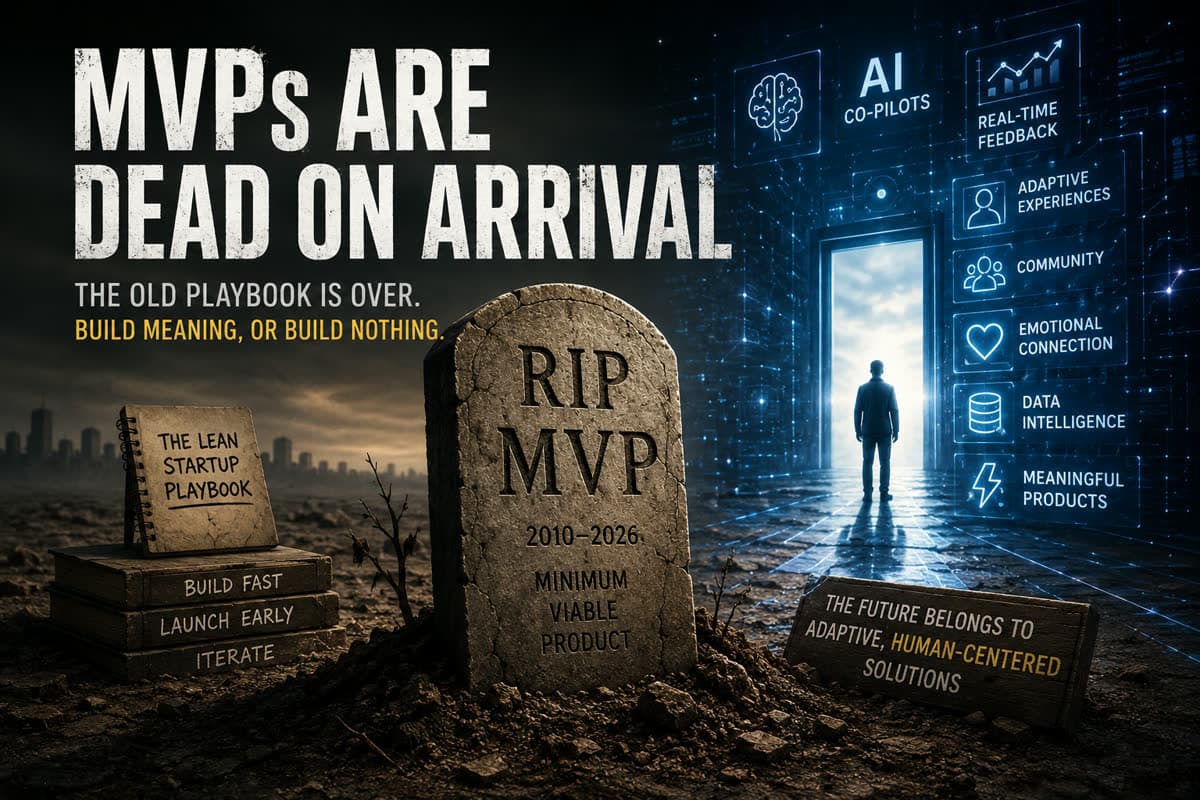
There is a strange silence forming beneath modern startup culture.
On the surface, everything appears louder than ever: more founders, more AI tools, more launches, more funding announcements, more products released daily than at any point in technological history.
Yet beneath the noise sits an uncomfortable reality. Most modern MVPs are already dead before users even touch them.
Not broken. Not poorly engineered. Not underfunded. Simply irrelevant on arrival.
The Doctrine of a Different Era
For years, the startup ecosystem worshipped the MVP, the Minimum Viable Product. It became doctrine inside incubators, accelerator programs, venture capital circles, and entrepreneurial culture itself. Build quickly. Launch early. Learn fast. Iterate continuously.
It was elegant advice for its time. But the environment that created the MVP no longer exists.
The original MVP emerged from an era where building software was expensive. Development cycles were slow. Engineering talent was scarce. User expectations were forgiving enough to allow rough products space to mature publicly.
Back then, functionality itself carried value. If a product merely worked, people noticed.
That world is gone.
Abundance, and the Collapse of Attention
In 2026, software has become abundant. AI has reduced the friction of creation so dramatically that products can now be prototyped in days, interfaces generated in hours, and entire SaaS businesses assembled with astonishing speed. The barriers that once protected builders have weakened almost completely.
And once creation becomes easy, another problem emerges: attention collapses.
The internet is now flooded with what can only be described as functional emptiness: AI wrappers, template startups, generic copilots, cloned productivity apps, and minimally differentiated software pretending to be innovation.
The result is not merely competition. It is saturation.
Users are exhausted. They scroll through infinite products the way people once scrolled through social posts, rapidly, emotionally detached, and instinctively filtering for relevance within seconds.
From Build-Risk to Care-Risk
This changes the meaning of an MVP entirely.
The old MVP philosophy assumed that the greatest uncertainty was whether something could be built. Today, the greater uncertainty is whether anyone will emotionally care that it exists.
That distinction is profound.
Because consumers no longer compare your early-stage startup against other startups. Consciously or unconsciously, they compare it against the best digital experiences they interact with daily: Spotify’s personalization, TikTok’s engagement loops, Apple’s interface precision, ChatGPT’s responsiveness.
The baseline itself has risen.
Which means many MVPs now fail not because the idea lacks potential, but because the product enters the market without enough gravity to interrupt modern attention systems. And attention, increasingly, may be the scarcest economic resource on earth.
The Paradox of the AI Era
This is the paradox of the AI era: products are easier to build than ever, yet harder to make meaningful than ever.
The startup ecosystem still speaks as though speed alone creates advantage. But when everyone can move fast, speed commoditizes instantly. Rapid execution no longer differentiates companies the way it once did.
The advantage shifts elsewhere. Toward perception, toward emotional resonance, toward cultural relevance, toward timing, toward understanding human behavior deeply enough to create products people attach themselves to rather than merely use.
The modern internet does not reward viability. It rewards significance.
This is why so many startups today feel strangely hollow despite technical competence. They are operationally efficient yet emotionally invisible. Perfectly functional but strategically forgettable.
Scarcity Logic vs. Overload Logic
The traditional MVP was built around the logic of engineering scarcity. Modern markets operate under the logic of cognitive overload.
Those are entirely different worlds.
In an environment of scarcity, being functional creates value. In an environment of abundance, being memorable creates value.
And memorability cannot be generated solely through lean methodology.
Where the MVP Still Earns Its Keep
The argument so far is sharpest when applied to consumer products fighting for attention. But software has more than one market, and the MVP critique does not apply with equal force to all of them.
B2B vertical software, the kind we build at Neo-2, still rewards lean iteration, because the buyer is not an audience. They are a collaborator. A property manager evaluating new infrastructure is not scrolling. They are sitting inside an operational problem, looking for a way out. They will tolerate roughness if the underlying logic of the product matches the shape of their pain.
In those markets, the MVP is not dead. It has changed shape. It is no longer a placeholder for what the product will become. It is the smallest coherent expression of a complete worldview.
The distinction is subtle but decisive. The old MVP was a fragment hoping to grow. The new one is a seed already containing the whole tree.
The Minimalism Trap
Ironically, the startup world’s obsession with minimalism may now be contributing to irrelevance itself. Founders strip products down so aggressively in pursuit of “viability” that they accidentally remove the very emotional experiences capable of generating attachment.
Users do not fall in love with viability. They fall in love with meaning.
This is why many of the strongest modern products no longer resemble traditional MVPs at all. They may still launch narrowly focused, but they are rarely emotionally incomplete. They arrive with identity. Narrative. Personality. Community gravity. They feel alive from the beginning.
The companies winning now increasingly understand something older startup philosophy underestimated: products are not competing solely for utility anymore. They are competing for psychological territory.
And psychological territory is not won through minimal functionality alone.
Taste Is the Skill the Lean Era Forgot to Teach
If memorability is the new currency, the obvious question is how it is produced. The uncomfortable answer is that it is not produced at all. It is exhaled.
Memorability is the residue of taste: the thousand small decisions made by someone with a strong point of view. It is not a deliverable. It is what is left behind when judgment has been applied consistently enough that the product begins to feel inevitable.
The lean startup era was excellent at training process operators. Build. Measure. Learn. It was not designed to train aesthetes. It did not train storytellers. It did not train people who could feel what was missing from a product before users articulated it.
This is why so many AI-era startups feel competent but anonymous. The bottleneck is not tools. It is not money. It is not even speed. It is taste. And taste cannot be A/B tested into existence.
The founders winning today decided what they liked before they decided what would convert. The order matters. Conviction is a starting condition, not an outcome to optimize toward.
From Machine to Organism
The deeper truth is that the modern business environment itself has changed shape. The old startup ecosystem operated like industrial engineering: structured, predictable, process-driven. Today’s ecosystem behaves more like biology: adaptive, chaotic, evolutionary, constantly mutating.
The company itself increasingly resembles a living organism rather than a machine.
Static playbooks weaken in such environments because the environment evolves faster than the framework designed to navigate it. By the time a strategy becomes mainstream, it is often already saturated.
This is partly why so many founders feel disoriented today. The old maps still exist, but the terrain no longer matches them.
Before the New Orthodoxy Becomes Theater
There is a final risk worth naming, because it is already happening.
Whatever replaces the MVP will be gamed the same way. Founders are already learning to perform narrative and personality without actually having either. Hire a brand designer before you know what you are trying to say. Publish a manifesto before you have a perspective. Stage a launch film before you have a product worth filming.
The next decade’s irrelevance will not be products that failed to be viable. It will be products that performed memorability, products that mistook the surface of meaning for meaning itself.
The honest move is not to replace one doctrine with another. It is to recognize that doctrines themselves are the trap. In overload markets, no methodology produces significance. Only judgment does. And judgment cannot be downloaded.
Earning the Right to Exist
The MVP is one of those maps. Useful once. Potentially dangerous now if followed blindly.
Because the modern challenge is no longer merely proving that a product can exist. The challenge is proving that it deserves to.
That is a much harsher question.
And perhaps this is the uncomfortable conclusion the startup world is slowly approaching: in an age where almost anything can be built, being merely viable may no longer be viable at all.
Written by
Fola Akinmolayan
Founder & CEO of Neo-2. Building eleven ventures across eleven industries from first principles.